

Enterprise application development is the key to making big companies run smoothly in 2026. Here, we show how it differs from regular web apps and explore the four main system types, such as ERP and CRM.
We look at the top tools for enterprise software development and why Canadian businesses need them to scale. By using the right enterprise application development tools, your company can save time and keep data safe while growing fast.
But before you get started, let’s tell you a little story here.
Meet Alex. Alex runs a busy shipping company in Ontario. Every morning, he sits down at a desk covered in yellow sticky notes. He has three different screens open. One shows the trucks’ locations. Another displays the employee schedules. The third is a massive spreadsheet tracking the money. None of these systems talks to the others. If a truck breaks down, Alex has to call five different people. He has to update the spreadsheet by hand. He has to adjust the schedule manually. Alex is tired. His company is growing, but his tools are not. He needs a system that does the heavy lifting for him. He needs enterprise application development.
If you feel like Alex, you’re in the right place. This post will show you how powerful enterprise software helps big businesses win.
What is Enterprise Application Development?
Enterprise application development is the process of creating sophisticated software systems for large organizations. Unlike small apps, these platforms manage massive volumes of data and seamlessly connect multiple departments within a single unified environment.
Enterprise applications are designed to support thousands of users simultaneously while keeping every part of your business connected. When you invest in enterprise software development, you’re building a custom tool tailored to your specific needs.
It doesn’t just handle a single task, but it supports everything your organization requires to operate, compete, and grow. This is more than just a simple website. It’s about creating the digital backbone of your company.
Enterprise Application vs Web Application
An enterprise application is a robust internal system designed for business use. It manages complex operations, handles large volumes of data, and connects multiple departments across an organization. A web application, on the other hand, is typically a lighter, more straightforward tool used by the general public through a web browser.
Many people assume these two are the same because they share some surface similarities. They both run over the internet. They both have buttons, forms, and screens. But under the hood, they are very different. Consider a public park versus a high-security laboratory. A public park (web application) is open and easy for anyone to enter. It’s simple, with a few clear paths and basic facilities.
A high-security laboratory (enterprise application) requires ID cards and strict access controls. It’s filled with complex equipment, sensitive information, and specialized workflows. It’s built for a specific group of experts, not for everyone.
That’s the core difference.
Web applications are usually designed for broad, public use, while enterprise applications are engineered to power critical, highly specialized processes within large organizations.
The Key Differences at a Glance
| Feature | Web Application | Enterprise Application |
| User Base | General public | Employees and partners |
| Complexity | Low to medium | Very high |
| Security | Standard | Extremely strict |
| Integration | Usually stands alone | Connects to many systems |
| Main Goal | User engagement | Business efficiency |
The Four Types of Enterprise Systems
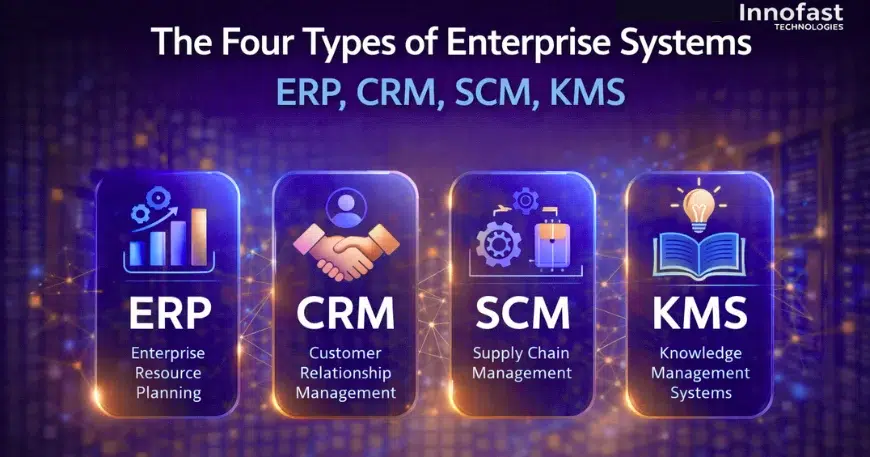
The four main types of enterprise systems are Enterprise Resource Planning (ERP), Customer Relationship Management (CRM), Supply Chain Management (SCM), and Knowledge Management Systems (KMS). Each focuses on a different part of the business, but together they form a unified whole.
To get the most value from enterprise application development, you need to understand which type best fits your needs. Most large companies in Canada use a combination of all four.
1. Enterprise Resource Planning (ERP)
This is the central brain of the company. It manages finances, people, and day-to-day operations. It ensures the finance team always knows what the HR team is doing and vice versa. Above all, it provides a single, reliable source of truth for the entire business.
2. Customer Relationship Management (CRM)
This system tracks every customer you sell to. It records what they prefer and when they last made a purchase. It helps your sales team close deals faster and ensures your customer support team always has access to each caller’s full history.
3. Supply Chain Management (SCM)
This system is designed for companies that move physical goods. It tracks items from the factory floor to the customer’s front door, giving you real-time visibility into every shipment. It minimizes waste, prevents stockouts, and helps you keep your inventory at the right levels.
4. Knowledge Management Systems (KMS)
This is like a central knowledge library for your business. It stores all your training materials, documents, and your team’s best ideas. It ensures that when an expert leaves the company, their knowledge remains. It also helps new employees get up to speed in their roles much faster.
Real World Enterprise Application Examples
Common enterprise application examples include automated payroll systems, global inventory trackers, and hospital patient portals. These tools take manual work and make it digital and automated.
Let’s look at how this works in real life.
In a city like Toronto, a major bank needs to keep track of millions of dollars. A simple off-the-shelf app isn’t enough for that. Instead, the bank uses custom enterprise software development to build a fraud detection system. This system monitors every transaction in real time. If something looks suspicious, it can pause or stop the payment instantly. It protects both the bank and its customers.
Another enterprise application example is a large retail chain in Vancouver with fifty stores. When someone buys a shirt in Vancouver, the warehouse in Calgary needs to know right away. The enterprise system automatically updates inventory levels for all stores simultaneously. This prevents the company from selling products it doesn’t have in stock and tells the factory when it’s time to produce more shirts.
Why Your Business Needs Enterprise Software Development
Investing in enterprise software development leads to better efficiency, higher security, and easier growth. It removes the bottlenecks that prevent a business from growing.
Just assume about your favourite coffee shop. When they only had one store, the owner could remember every order. But once they have a hundred stores, they need a system. Enterprise application development allows you to scale. It means your business can grow from 10 employees to 1000 without breaking.
1. Better Data Security
In Canada, we follow strict regulations such as PIPEDA, which require you to keep customer data safe. Custom software is designed with these rules in mind. It uses advanced security measures to keep hackers out and tracks who accesses which data and when.
2. Improved Scalability
A basic tool might work for now, but what happens when you have ten times as many customers? Modern enterprise application is built for scalability. As your business grows, your software grows stronger with it. By leveraging cloud computing, it can handle increasing traffic and workloads without slowing down.
3. Better User Experience
If a tool is hard to use, your team won’t want to use it. Professional enterprise software development prioritizes user experience, making complex tasks feel simple. This results in higher satisfaction, better adoption, and less training time for new staff.
If you want to shape your infrastructure while keeping operations smooth, Custom Enterprise Software Development is the only way to go.
Modern Enterprise Application Development Tools
Enterprise application development tools in 2026 include low-code platforms such as Mendix and OutSystems, as well as professional development tools such as Visual Studio Code and Docker. These solutions help teams build large, complex systems faster and with fewer errors.
Not long ago, building these systems could take years.
Today, modern enterprise application development tools dramatically speed up the process. Low-code platforms let you create parts of an application by dragging and dropping visual components, which is ideal for rapid development and prototyping.
More advanced tools are built for expert developers who write and optimize the underlying code.
The Best Tools for 2026:
- Mendix: Excellent for integrating with SAP and other large-scale enterprise systems.
- Microsoft Power Apps: Ideal for organizations already using Microsoft 365.
- OutSystems: Well-suited for building enterprise-grade applications with robust, extensible code.
- Visual Studio Code: A leading code editor that helps developers write clean, maintainable code.
- Docker: Ensures applications run consistently across different servers and environments.
- GitHub Copilot: An AI coding assistant that accelerates development by suggesting code in real time.
The Impact of Application Architecture and Legacy Systems
Strong application architecture ensures your software is easy to update, scale, and repair. Most large enterprises struggle with legacy systems, such as outdated tools that no longer meet modern business needs. Enterprise application development helps you gradually move away from these systems and into a more flexible, future-ready environment.
Many Canadian businesses are still relying on legacy platforms built decades ago. These systems are slow, hard to integrate, and often cannot communicate with modern applications.
Modernizing them is a core focus of enterprise software development. A skilled development team will design a modern application architecture, much like building a house with modular rooms.
If you need to remodel the kitchen, you don’t have to tear down the entire house. In the same way, modular software lets you update a single component without disrupting the rest. Over time, it makes your systems far more cost-effective and easier to maintain.
How the Development Process Works
The process typically involves planning, design, development, testing, and deployment. In 2026, there are more than one software development methodology, but most teams follow Agile methodologies, meaning they build small parts of the application, test them, and refine them before moving on.
You don’t want to wait a full year to see your new software in action. That’s why modern teams work in small, iterative steps.
They share progress with you every two weeks, so you can provide feedback early and often. The approach helps ensure the final product aligns closely with your needs.
It also includes rigorous testing at every stage to minimize bugs and performance issues with a practice known as quality assurance.
Build Your Digital Destiny with Innofast
Alex from our story finally got his enterprise system. Now, when a truck breaks down, the system automatically finds a replacement.
The schedule updates itself. The spreadsheet stays accurate. Alex has time to go home and see his family. His business is earning more because it runs more efficiently. This is the power of enterprise application development.
If you’re ready to move beyond sticky notes and start scaling, we can help. At Innofast, we bring together the right experts to build your ideal software. We understand the Canadian market, and we know how to scale.
You don’t have to do it alone. We can bridge the gap between your ideas and a fully working system.
Frequently Asked Questions
1. What is enterprise software?
Enterprise software is a collection of computer programs used by an organization to perform big tasks. This includes things like managing payroll, tracking sales, and coordinating shipping. It is built for a large number of users.
2. What is the main purpose of ERP?
The main purpose of ERP is to integrate all the different parts of a business into one system. It allows data to flow between departments so everyone is looking at the same information. This stops mistakes and saves time.
3. What is the difference between ERP and an enterprise management system?
An ERP is a type of software that focuses on internal operations, such as finance and HR. An enterprise management system is a broader term. It can include ERP, CRM, and other tools that manage the whole organization and its partners.
4. Why is scalability important in enterprise software?
Scalability is important because your business will grow. If your software cannot handle more users or more data, it will crash. This costs you money and makes your customers unhappy.
5. How does cloud computing help enterprise apps?
Cloud computing allows your software to run on powerful servers on the internet. This means your team can access the app from anywhere. It also makes it easier to add more power when you need it.

