


Staff Augmentation vs Managed Services: Which Model Is Right for Growing Businesses?
The core difference in the staff augmentation vs. managed services debate lies in who owns the outcome and who manages the daily work. Staff augmentation involves adding temporary experts to your existing team under your direct management to fill specific skill gaps.
In contrast, managed services involve outsourcing an entire function, such as your IT infrastructure or cybersecurity, to a provider that takes full responsibility for the results.
For Canadian small businesses, the choice depends on whether you have the internal bandwidth to lead people or if you prefer a hands-off solution with predictable monthly costs. But the truth is that both models have their place in the Canadian business topography.
A Microsoft survey shows that 94% of Canadian SMBs consider digital technologies integral to their revenue strategies. They do it because hiring full-time staff in cities like Toronto or Vancouver is costly.
Let’s break down these two paths so you can choose the one that actually helps you grow.
Understanding the Choice: Staff Augmentation vs. Managed Services
Staff augmentation and managed services are two ways to get professional help for your company. Staff augmentation is a model in which you hire external talent to work on your team. Managed services is a model in which you outsource an entire business function to experts.
What is IT Staff Augmentation?
Staff augmentation is a flexible staffing strategy that involves temporarily hiring external professionals to fill specific gaps in your existing workforce.
You manage these individuals just as you do your regular employees. They follow your processes, use your tools, and report directly to your managers.
What are Managed IT Services?
Managed services involve outsourcing the full responsibility of a specific function, such as cybersecurity or cloud management, to an external provider.
You do not manage the people. Instead, you agree on a set of results, and the provider ensures they are met.
Looking for a specific expert to help your team right now? Our IT Staff Augmentation will help you find the right talent for your next big project.
Key Operational Differences for Canadian SMBs
While both models give you access to talent, they change how your office runs on a day-to-day basis.
One requires you to be a coach, while the other requires you to be a partner.
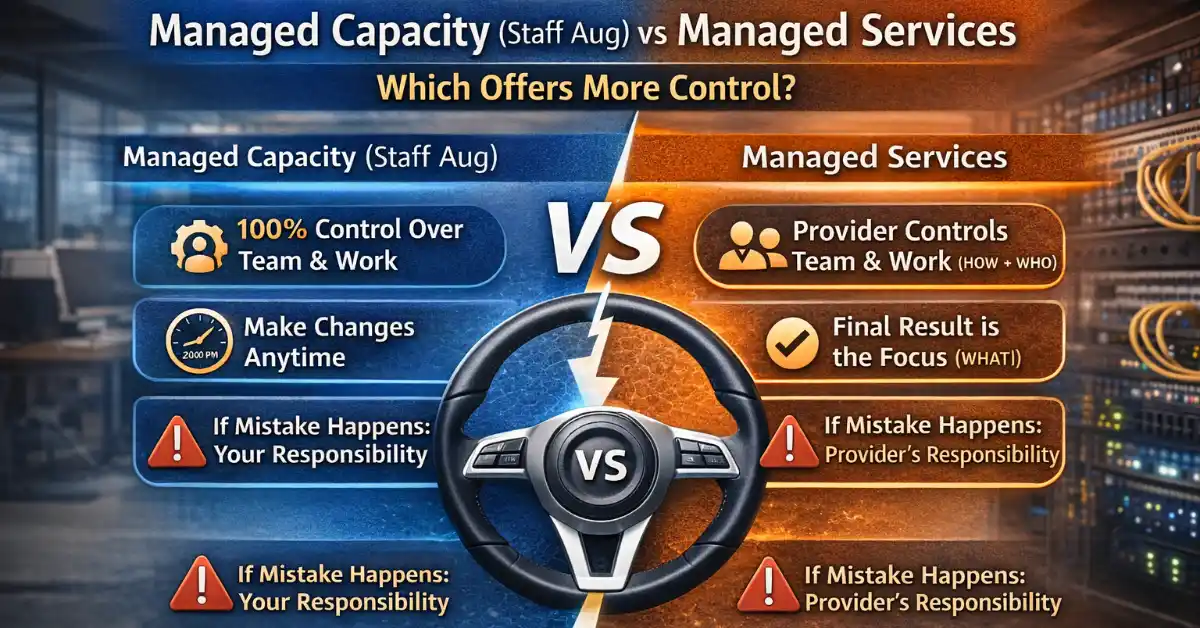
Managed Capacity (Staff Aug) vs Managed Services: Which Offers More Control?
Managed capacity (staff aug) vs managed services differ most in who holds the steering wheel. In a managed capacity or staff augmentation model, you retain 100% control over the work. If you want to change the project direction at 2:00 PM on a Tuesday, you just tell the augmented staff.
In managed services, the provider controls the HOW and the WHO, while you only care about the final WHAT!
Staff Augmentation vs Outsourcing (Managed Service): The Responsibility Gap
The debate of staff augmentation vs outsourcing (managed service) is really about who is to blame if something goes wrong. If an augmented staff member makes a mistake, the responsibility stays with your internal manager.
However, in a managed service model, the provider assumes the risk. If your network goes down, the managed service provider is contractually obligated to restore it within a specified timeframe.
Managed Services vs Staff Augmentation Pros and Cons
Every business is unique. What works for a tech startup in Waterloo might not work for a law firm in Ottawa. To make the best choice, weigh the pros and cons of managed services vs. staff augmentation against your specific goals.
| Feature | Staff Augmentation | Managed Services |
| Management | You manage the daily tasks. | The provider manages everything. |
| Flexibility | Massive (scale up or down fast). | Medium (based on your contract). |
| Setup Time | Very fast (onboard an individual). | Slower (requires a complete system audit). |
| Risk | You keep the project risk. | The provider shares the risk. |
| Training | You must train them in your ways. | No training needed (they are experts). |
| Long-Term Cost | It can become expensive over time. | Usually, it is more cost-effective in the long term. |
Pros of Staff Augmentation
- Direct Control: You see what they are doing every hour.
- Ease of Integration: They sit in your meetings and use your Slack.
- Fast Scaling: You can add one developer today and release them in a month.
Cons of Staff Augmentation
- High Management Overhead: You need a manager who has the time to watch them.
- No Institutional Knowledge: When they leave, their knowledge often goes with them.
Pros of Managed Services
- Predictable Budget: You pay a flat monthly fee.
- Peace of Mind: You do not have to worry about how things work.
- Broad Expertise: You get a team of experts rather than just one person.
Cons of Managed Services
- Less Control: You cannot tell them exactly how to write every line of code.
- Contractual Limits: Changing the scope of work might require a new agreement.
Cost Analysis: Managed IT Services Cost for a Small Business
The managed IT services for a small business are typically structured as a fixed monthly fee, whereas staff augmentation is usually billed by the hour.
Think about it. If you hire an augmented staff member for $80 per hour, you pay for every hour they sit at their desk. If the project takes longer, you pay more.
This is great for short bursts of work.
However, for ongoing needs like 24/7 security, affordable managed IT services for small businesses are usually the better deal. You pay a set price for the outcome. If it takes the provider 10 hours or 50 hours to keep you safe, your price stays the same.
This makes your yearly budgeting much easier.
The Strategic Hybrid Approach for Growth
Many successful Canadian companies do not choose just one door. They use a blend of both.
But there’s the kicker! You might use a managed service provider to handle your core infrastructure, backups, and security.
This ensures your lights stay on without you having to think about it. Then, when you have a special project, such as launching a new mobile app, you use staff augmentation to bring in a specialized designer for 3 months.
This hybrid model gives you the stability of managed services and the agility of staff augmentation.
Common Challenges We Solve for Canadian Businesses
Small businesses in Canada face unique hurdles, from PIPEDA compliance to a tight labour market. Our services are designed to bridge these gaps.
The Lack of Local Talent
In many parts of Canada, finding a niche expert like a Cloud Architect is nearly impossible. Staff augmentation lets you borrow talent without moving them to your city.
The Management Burnout
As a founder, you are already busy. If you hire five contractors, you now have five more people to manage. Managed services take that burden off your plate so you can focus on your customers.
Regulatory Pressure
Keeping up with data privacy laws in Canada is a full-time job. Managed service providers stay up to date on these laws, so you do not have to.
Which Model is Right for Your Business?
Choosing between these two models is about looking in the mirror and being honest about your team’s capacity. If you have a strong manager who just needs more hands to get work done, staff augmentation is your best bet.
If you find that technology is a BLACK BOX that you just want to work flawlessly every morning, managed services are the answer.
Don’t let tech hurdles stop your momentum anymore!
