

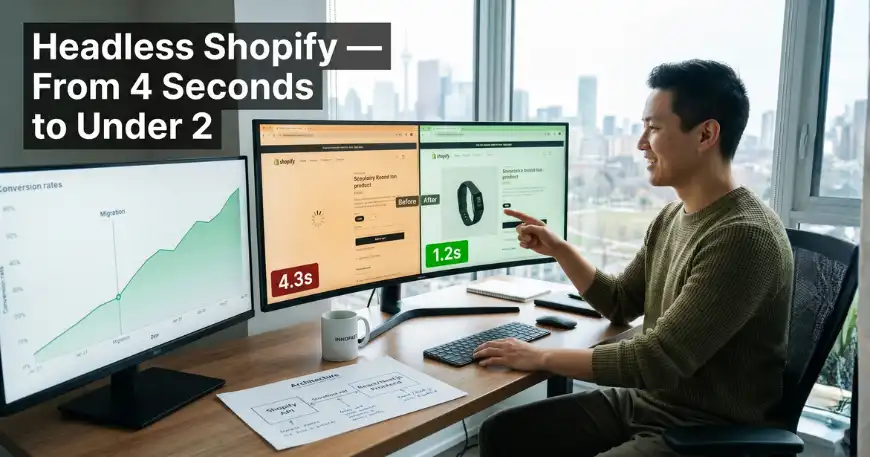
Headless Shopify separates your store’s frontend from Shopify’s backend, and high-growth brands are making the move because Shopify’s Liquid templating language can’t keep up with scale.
Page speeds plateau, mobile experiences feel templated, and every new app integration slows the store down further.
The fix is a React and Next.js frontend connected to Shopify’s Storefront API. Brands that migrate consistently report conversion rate improvements of 20–30% and load times cut from 6+ seconds to under 2 seconds.
If your store is scaling past $1M in annual revenue, this is exactly how to do it right, without disrupting your business in the process.
What the Shopify Liquid Ceiling Actually Costs You
Shopify’s Liquid templating language does one thing well: it renders product data into HTML quickly and consistently.
The problem is that it’s a server-side language tightly bound to Shopify’s rendering pipeline. Every customisation, every new feature, and every performance fix happens inside a closed system you don’t fully control.
A recent analysis of over 500 Shopify themes found that 78% contain critical Liquid performance bottlenecks that add 2–4 seconds to page load times. That directly translates to cart abandonment and lost revenue.
The average scaling Shopify store also runs 15–25 apps, each injecting scripts and stylesheets that compete for browser resources.
What was once a 1.9-second load can balloon to 4.3 seconds after adding review apps, loyalty widgets, live chat, and a product recommendation engine.
There are hard structural limits too.
Liquid imposes a 256KB file size cap per file. Building advanced features like custom B2B portals, multi-locale storefronts, or dynamic landing page builders runs into those constraints fast.
Enterprise brands in the $5M–$50M revenue range feel this most acutely; the gap between what they need and what themes can deliver widens with every product launch.
Heads Up: The solution isn’t to leave Shopify behind. It’s to separate its powerful commerce backend from its frontend rendering entirely. That’s exactly what headless architecture does.
How Next.js and React Transform the Mobile Shopping Experience
Mobile now drives over 75% of global e-commerce website traffic and accounts for 59% of all online retail sales worldwide, yet most Liquid-based storefronts still feel like desktop experiences shrunk to fit a smaller screen.
The problem isn’t responsiveness; most Shopify themes handle that adequately. The problem is interactivity: persistent carts, smooth product transitions, real-time filtering, and the fluid experience that keeps mobile shoppers engaged.
React and Next.js solve this by shifting rendering logic to the client and the edge, rather than Shopify’s servers.
With Next.js 15’s App Router, developers build hybrid server-side rendered (SSR) and client-side rendered (CSR) storefronts that load instantly and then behave like native apps.
State management tools like Zustand power persistent carts and overlay drawers that update in real-time without page reloads, a fundamental UX improvement over Liquid’s full-page refresh model.
React’s component model means product cards, collection grids, and checkout flows are built once and deployed everywhere consistently.
Next.js’s Incremental Static Regeneration (ISR) caches product pages at the edge globally, cutting latency for international shoppers. The result is a shopping experience that doesn’t just look better, it performs better, with measurable lifts in session duration, pages per visit, and conversion rate.
For brands investing in mobile app development alongside their web storefront, Next.js isn’t just a frontend framework. It’s the experience layer that converts browsers into buyers.
Why Load Times Degrade Over Time, And How to Stop It
Load time degradation is rarely a single problem. It’s cumulative. https://innofast.tech/mobile-app-development
An unoptimised hero image here, a third-party analytics script there, a slow database query during checkout, individually minor, collectively catastrophic. Studies consistently show that 53% of mobile users abandon a site that takes longer than 3 seconds to load. Each additional second compresses conversions further.
A headless architecture interrupts this degradation pattern at its root.
With Next.js, developers implement multi-layer caching: ISR at the CDN layer, React Server Components to minimise client-side JavaScript bundles, and lazy-loading for below-the-fold images and components.
The frontend and backend can be optimised independently. You can refactor product page rendering without touching order management logic.
Performance budgets become enforceable, and monitoring tools like Google PageSpeed Insights or Lighthouse CI can be integrated into the deployment pipeline to catch regressions before they reach production.
The practical impact is significant.
Stores that migrate to headless architectures report conversion rate improvements of 20–30%, according to data from Gitnux and Netguru’s 2026 analysis of headless commerce implementations
How Headless Architecture Helps You Win on Google’s Core Web Vitals
Core Web Vitals, Largest Contentful Paint (LCP), Interaction to Next Paint (INP), and Cumulative Layout Shift (CLS) are now direct Google ranking signals.
Failing these metrics isn’t just a user experience problem. It’s a visibility problem.
The benchmarks are demanding: LCP must be under 2.5 seconds, INP under 200ms, and CLS below 0.1.
Liquid-based storefronts routinely struggle with LCP because render-blocking scripts delay the first meaningful paint. Dynamic sections, promotional banners, app injections, and shift layout as they load, hurting CLS scores.
A 0.1-second improvement in load speed increases conversion rates by 8.4% for retail e-commerce.
Sites with optimised Core Web Vitals see higher dwell times and lower bounce rates.
Headless Next.js architecture addresses this structurally. The App Router enables granular font and image optimisation built directly into the framework.
React Server Components reduce client-side JavaScript, directly improving INP. CSS containment strategies prevent layout shifts, protecting CLS scores. For e-commerce brands where organic search drives significant acquisition, these aren’t vanity metrics. They’re revenue drivers.
Pro Tip: Sites that consistently hit green Core Web Vitals scores see compounding SEO gains over time, better rankings, higher click-through rates, and sustained organic traffic growth.
The Design Freedom That Only a Decoupled Frontend Delivers
One of the most underappreciated benefits of going headless is what it does for your creative team.
In a Liquid theme, every visual decision is constrained by Shopify’s schema, section limits, block restrictions, and template structures that are difficult or impossible to override without risking compatibility when the theme updates.
In a headless setup, Shopify becomes a pure commerce API.
Product data, inventory, pricing, discounts, and checkout logic all live in Shopify’s backend. The frontend is a completely independent application, built in React/Next.js, styled to your brand demands, and deployed to any infrastructure.
Designers can implement motion-rich product detail pages, editorial-style collection pages, custom mega menus, and personalised layouts with no compromise to the backend.
This decoupling also separates deployment cycles, and that matters operationally.
Frontend teams can ship UI updates, A/B tests, and new landing pages without triggering backend deployments. Backend teams can update product data, pricing rules, and integrations without touching the storefront.
Both teams move faster, independently. For brands with aggressive creative and marketing roadmaps, this separation is transformative.
How One Backend Powers Your Entire Omnichannel Operation
Headless architecture isn’t just about faster websites.
It’s about powering every customer touchpoint from a single source of truth. With Shopify’s Storefront API, one backend simultaneously serves a web storefront, a native mobile app, a progressive web app (PWA), an in-store kiosk, and IoT or POS integrations, all with consistent inventory, pricing, and checkout logic.
Brands with weak omnichannel coverage lose customers at every gap between channels.
Headless removes those gaps entirely. For brands with physical retail, wholesale portals, or mobile app ambitions, the single-backend model also dramatically reduces infrastructure complexity and maintenance overhead.
Our web app development team builds these unified systems across industries, and what we consistently see is that brands underestimate the operational savings of a single-backend model. One integration to maintain instead of five.
One source of inventory truth instead of three.
The Migration Roadmap: How to Move from Liquid to Headless Without Disrupting Your Business
A headless migration doesn’t need to be an overnight switch. The most successful migrations follow a phased approach that preserves SEO equity, maintains operational continuity, and reduces business risk.
Phase 1, Audit and Architecture (Weeks 1–4): Assess your current tech stack, document all third-party app dependencies, and map your customer journey touchpoints.
Enable Shopify’s Headless channel and confirm Storefront API access.
This is also the stage to select your frontend framework (Next.js is the dominant choice in 2026), your CMS for content (Contentful, Sanity, or Hygraph are common pairings), and your hosting infrastructure (Vercel or Netlify for edge delivery).
Phase 2, Hybrid Build (Months 2–3): Rather than rebuilding everything at once, start with your highest-traffic pages, typically the homepage, collection pages, and product detail pages.
Build these in Next.js connected to Shopify’s Storefront API while keeping the rest of the store on Liquid. This hybrid model lets you test real performance gains in production, catch integration issues early, and keep the business running without disruption. Your checkout can remain on Shopify’s native checkout throughout.
Phase 3, Full Migration and Launch (Months 4–5): Migrate remaining pages, implement 301 redirects to preserve SEO rankings, connect all third-party integrations via API rather than app scripts, and configure your monitoring stack.
Establish performance baselines and set alert thresholds so regressions are caught immediately.
Phase 4, Optimise and Scale Post-launch, run A/B tests on key conversion points, iterate on Core Web Vitals, expand to additional channels, mobile app, kiosk, wholesale portal, and introduce personalisation layers using unified customer data.
The total timeline typically runs 4–6 months for a mid-size brand. Working with an experienced development partner compresses that significantly and avoids costly architectural mistakes.
You can see the full range of our technical services to understand where headless development sits within a broader digital transformation strategy.
Best Practice: Never migrate all pages at once. The hybrid approach in Phase 2 is what protects your existing SEO rankings and keeps operations stable while you build.
Is Headless Worth It for Canadian SMBs? The Honest Cost-Benefit Answer
A headless Shopify build typically costs between $25,000 and $150,000 CAD in initial development, depending on complexity, the number of channels, and the degree of custom functionality required.
Add Shopify Plus fees of approximately $3,400 CAD per month (billed annually on a 3-year term), hosting on Vercel or similar at $20–$500/month (and $500+ for high-traffic stores), and ongoing development and maintenance costs.
Year-one total cost of ownership for a mid-tier headless build generally lands between $120,000 and $250,000 CAD.
The ROI case is compelling for the right businesses.
Conversion rate improvements of 20–30% are commonly reported after headless migrations driven by load time reductions alone.
A brand doing $3M CAD annually with a 2% conversion rate that improves to 2.5% gains $750,000 in incremental revenue, dwarfing the development investment. Eliminating app bloat also cuts monthly subscription costs, and a unified omnichannel infrastructure prevents the cost of building separate systems for web, mobile, and retail.
The infrastructure prevents the cost of building separate systems for web, mobile, and retail.
Go headless if you’re:
- A Canadian SMB with $1M+ in annual e-commerce revenue
- A growth-stage DTC brand with a complex product catalogue (500+ SKUs)
- A business with physical retail or wholesale channels to integrate
- A brand investing in mobile app development alongside its web storefront
Stay on an optimised Shopify theme if:
- Your store generates under $500K annually, the ROI math doesn’t support the investment at lower revenue thresholds
- You don’t have dedicated development resources to maintain a headless frontend
For Canadian businesses in particular, the performance edge matters beyond just domestic markets. Whether serving shoppers in Toronto, Vancouver, or internationally, edge-deployed headless storefronts deliver consistently fast experiences across geographies that centralised rendering can’t fully match.
The Bottom Line on Going Headless
Moving from Shopify Liquid to a headless architecture isn’t a technical upgrade for its own sake.
It’s a strategic decision about what kind of brand you intend to build, and what your infrastructure needs to support over the next five years.
Brands that make the move consistently report faster iteration cycles, better SEO performance, higher mobile conversion rates, and the operational freedom to pursue omnichannel commerce without architectural compromise.
The technology, Next.js, React, Shopify’s Storefront API, is mature and battle-tested. The migration paths are well-documented.
What separates brands that execute this transition successfully from those that struggle is the quality of the development partnership and the clarity of the strategic brief going in.
After helping clients across industries navigate this exact transition, from initial architecture decisions through to full deployment and ongoing optimisation, one thing is clear: the brands building for the next five years aren’t waiting for their themes to slow them down.
The question isn’t whether to go headless. It’s whether you start before or after your competitors do.
Frequently Asked Questions About Headless Shopify
Is headless Shopify worth the cost for small businesses?
Not at every stage. Stores generating under $500K annually are generally better served by an optimised Shopify theme. Once you cross $1M in annual revenue, the ROI case becomes much stronger.
How do I improve mobile conversion rates for my Shopify store?
The biggest lever is moving away from Liquid’s full-page refresh model. A React and Next.js frontend delivers persistent carts, real-time filtering, and smooth product transitions that feel native on mobile.
Is headless Shopify faster than a standard theme?
Yes, significantly. Standard Liquid themes regularly load in 4–6 seconds as your app stack grows. A headless build using Next.js with edge caching consistently brings that under 2 seconds.
Do I lose Shopify’s checkout if I go headless?
No. Your checkout remains on Shopify’s native checkout throughout the migration. Shopify’s checkout already has industry-leading conversion optimisation built in, so there’s no reason to replace it.
How long does a headless Shopify migration take?
For a mid-size brand, the full migration typically runs 4–6 months. A phased approach keeps the business running without disruption while you build and test in production.

