

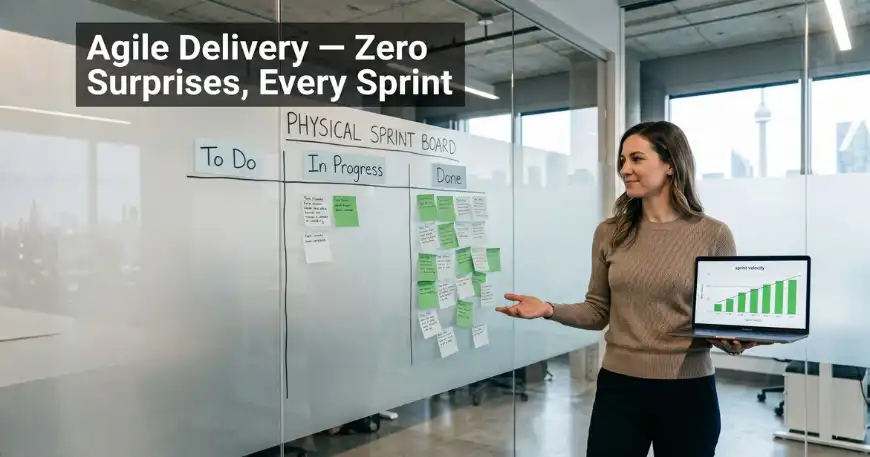
If you’ve worked with offshore teams before, you already know the biggest challenge: unpredictable delivery.
Missed deadlines, unclear progress, and last-minute surprises are common in traditional outsourcing models. That’s why many Canadian companies are now shifting toward a more structured agile delivery framework—one that focuses on transparency, speed, and measurable outcomes.
At Innofast, we’ve built a predictable software delivery framework designed specifically for Canadian projects. It combines structured sprint cycles, real-time reporting, and strong QA processes to ensure consistent results—without the typical offshore risks.
The goal is simple: deliver working software every sprint, with zero surprises.
Let’s break down how it works!
Why Most Offshore Projects Fail (and How to Fix It)
Most offshore projects don’t fail because of talent—they fail because of process gaps and lack of structure.
In many cases, teams are skilled, but the agile outsourcing workflow is either unclear or poorly managed. Without defined processes, even experienced teams struggle to deliver consistent results.
Common issues include:
- Lack of clear sprint structure
- Poor communication across time zones
- No visibility into progress
- Weak QA and delayed testing
These problems often lead to missed deadlines, rework, and growing uncertainty for stakeholders.
This is where a structured offshore agile development process makes the difference.
Instead of long and uncertain delivery cycles, agile breaks the project into smaller, manageable units with defined goals. Each sprint produces a working increment, giving clients early visibility and the ability to validate progress before moving forward.
Fixing offshore failure starts with one principle:
Short cycles + continuous validation = predictable outcomes
The Two-Week Sprint: Building Demonstrable Software Increments
At the core of a reliable agile delivery framework is a well-defined sprint cycle.
We follow a two-week sprint model, which provides a clear structure for planning, execution, and review. Each sprint starts with prioritized tasks and ends with a working product increment that can be tested and validated.
This approach is a key part of an effective agile outsourcing workflow, especially when working with distributed teams. It ensures that work is broken down into achievable goals rather than long, uncertain timelines.
By following remote sprint management best practices, teams can:
- Maintain consistent progress across time zones
- Quickly identify blockers
- Adjust priorities based on feedback
Instead of waiting months for a full release, stakeholders receive demonstrable software every two weeks, reducing risk and improving decision-making.
The result is a structured and predictable development cycle where progress is visible and measurable at every stage.
The Importance of the End-of-Sprint Demo
The end-of-sprint demo is a critical checkpoint in any agile delivery framework.
At the end of each two-week cycle, the team presents a working version of the product. This is not a report or update—it’s live, functional software that stakeholders can review and interact with.
This step plays a key role in maintaining a predictable software delivery framework because it allows:
- Immediate validation of completed work
- Early identification of gaps or misunderstandings
- Faster decision-making for upcoming sprints
For Canadian teams working with offshore partners, this reduces dependency on assumptions and ensures alignment after every cycle.
It also supports predictable delivery for fixed-budget software projects, as issues are caught early rather than after full development.
In simple terms, the demo ensures that every sprint delivers real value not just progress on paper.
Transparent Reporting and the “No-Surprises” Delivery Model
Lack of visibility is one of the biggest risks in offshore development. Without clear updates, stakeholders are left guessing about progress, timelines, and potential issues.
That’s why a strong agile delivery framework must include transparent software reporting at every stage.
At Innofast, reporting is structured, consistent, and real-time. Clients always have access to:
- Completed tasks and delivered features
- Work in progress with current status
- Identified risks or blockers
Using the best tools for transparent offshore project management such as Jira, ClickUp, and shared dashboards, we ensure that every update is visible and traceable.
This level of transparency supports a true no-surprises delivery model, where issues are flagged early and handled before they impact timelines or budget.
The result is full control and confidence clients know exactly where the project stands at any point in time.
Managing QA and Technical Debt in High-Velocity Projects
Speed without quality creates long-term problems. That’s why qa in offshore development must be built into the process, not added at the end.
In a high-velocity agile delivery framework, testing runs alongside development. This ensures issues are identified early, reducing rework and keeping the project on track.
Key practices include:
- Continuous testing during each sprint
- Regular code reviews for stability and performance
- Clear bug tracking and resolution workflows
At the same time, we focus on managing technical debt in agile offshore development. Without proper control, rapid development can lead to unstable code and future scalability issues.
To manage this, teams:
- Refactor code regularly
- Maintain clean architecture
- Prioritize long-term maintainability alongside speed
This balance ensures that fast delivery does not compromise quality, keeping the product stable as it scales.
Integrating Automated Testing into the CI/CD Pipeline
To maintain consistency at scale, automation becomes essential in any agile delivery framework.
We integrate automated testing directly into the CI/CD pipeline so that every code change is validated in real time. This reduces dependency on manual testing and ensures faster, more reliable releases.
As part of a modern offshore agile development process, this setup allows teams to:
- Run automated tests on every code commit
- Detect bugs early before they reach production
- Maintain consistent quality across all sprints
This approach also strengthens qa in offshore development by making testing continuous rather than reactive.
For Canadian projects where timelines and quality expectations are strict, automation helps reduce delays and ensures that each release meets defined standards.
The result is faster delivery cycles with fewer errors and higher confidence in every deployment.
Feedback Loops: Aligning Offshore Output with Canadian Business Goals
Even with strong execution, offshore projects can fail if the output is not aligned with business goals. That’s why feedback loops are a critical part of any agile delivery framework.
In a structured agile outsourcing workflow, feedback is not delayed until the end—it happens continuously throughout the project lifecycle. This ensures that development stays aligned with evolving requirements and market expectations.
Key feedback mechanisms include:
- Regular sprint reviews with stakeholders
- Ongoing backlog refinement based on priorities
- Direct communication between business and technical teams
These practices follow proven remote sprint management best practices, helping bridge the gap between offshore teams and Canadian stakeholders.
The goal is to ensure that what is being built is always relevant, usable, and aligned with real business outcomes—not just technical completion.
Governance: Handling Project Pivots Without Breaking the Budget
Change is a normal part of software development, especially in long-term projects. The challenge is not avoiding change, but managing it without losing control of scope, cost, or timelines.
Within a structured agile delivery framework, governance ensures that every change request is evaluated before it impacts the sprint plan. This keeps development aligned with a predictable software delivery framework, even when priorities shift.
At Innofast, governance is handled through:
- Controlled scope change approval processes
- Prioritized backlog reordering based on business value
- Sprint-level planning adjustments without disrupting overall delivery
This approach is especially important for predictable delivery for fixed-budget software projects, where financial limits must be respected while still allowing flexibility.
The key outcome is simple: teams can pivot when needed, but never lose control of budget or delivery stability.
The Final Outcome: Predictable Delivery for Canadian Agile Projects
When all parts of the agile delivery framework work together sprint cycles, transparent reporting, strong QA, and structured governance the result is consistent and predictable delivery.
For Canadian businesses working with offshore teams, this means fewer surprises and more control over outcomes. Instead of reacting to delays or misalignment, stakeholders can track progress in real time and make informed decisions at every stage.
This model transforms traditional outsourcing into a predictable software delivery framework, where every sprint adds measurable value and every release is aligned with business goals.
Common FAQs on The Agile Delivery Framework
1. What roles are best for IT staff augmentation?
IT staff augmentation works best for roles like software developers, QA engineers, DevOps specialists, UI/UX designers, and project managers who can quickly integrate into an existing agile team.
2. Why would a company outsource their IT?
Companies outsource IT to reduce costs, access global talent, speed up development, and scale teams quickly without long-term hiring commitments.
3. How to run agile sprints with offshore teams?
Successful offshore sprint execution requires clear sprint planning, defined goals, daily communication, shared tools like Jira, and regular sprint demos for feedback.
4. Why do most offshore software projects fail and how to fix it?
Most offshore projects fail due to poor communication, lack of structure, and weak QA. A structured agile delivery framework with transparent reporting solves these issues.
5. How do you manage quality in offshore agile projects?
Quality is maintained through continuous testing, QA integration in every sprint, automated testing in CI/CD, and regular code reviews.
6. What tools are best for transparent offshore project management?
Tools like Jira, ClickUp, Trello, Slack, and GitHub are commonly used to ensure transparency, track progress, and manage distributed agile teams effectively.
7. How do you handle changing requirements in agile offshore projects?
Changes are managed through structured governance, backlog prioritization, and sprint-level adjustments without disrupting overall project flow.

