

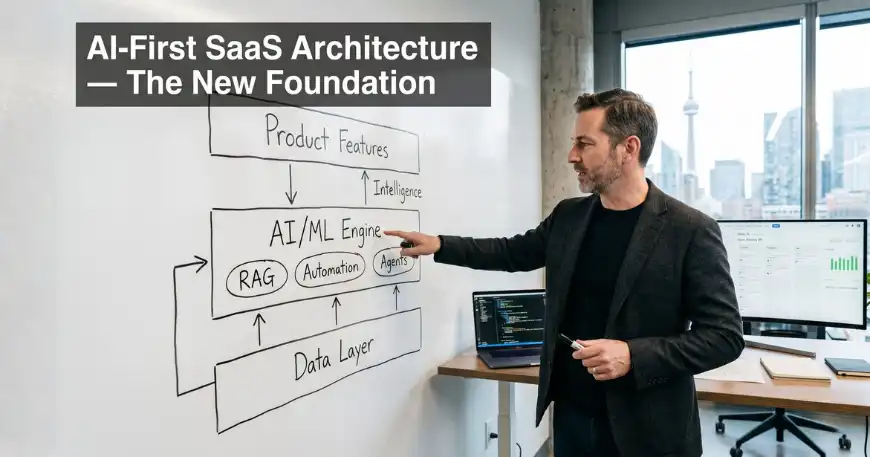
If your SaaS product still treats AI as an add-on feature, you’re already behind.
In 2026, the shift is clear: AI is no longer a feature—it’s the foundation of modern SaaS platform architecture. Companies that rely on traditional workflows are facing slower product evolution, limited personalization, and weaker competitive positioning.
This is where AI in SaaS is changing the game—not just by adding automation, but by redefining how software is built, how data is used, and how decisions are made in real time.
At Innofast, we consistently see one pattern across Canadian SaaS companies:
Teams that embed AI into their core architecture move faster, adapt quicker, and deliver more value per release.
The gap is no longer about having AI it’s about how deeply AI is integrated into your system.
Let’s break down what that actually looks like in practice!
Moving from “AI-enabled” to “AI-first” SaaS Strategy
Most SaaS platforms today are still AI-enabled, not AI-first—and that difference directly impacts growth and scalability.
An AI-enabled product typically adds features like chatbots or basic automation on top of an existing system. While useful, these features don’t change how the product fundamentally works. In contrast, an AI-first approach rebuilds the core logic of the platform around data, learning, and continuous optimization.
This shift is essential for modern saas platform architecture, especially as users expect smarter, faster, and more personalized experiences.
In an AI-first model:
- Data is continuously collected and used to improve outputs
- User interactions directly influence system behavior
- Features evolve dynamically instead of staying static
This is the foundation of intelligent software features development, where the product improves without constant manual updates.
The key shift is – AI is no longer supporting the system it is driving the system.
The Middleware Layer: Connecting LLMs to Proprietary Enterprise Data
AI models are powerful, but on their own, they don’t understand your business.
To make AI in SaaS actually useful, you need a structured way to connect models with your internal data. This is where the middleware layer becomes critical in modern saas platform architecture.
Middleware sits between:
- LLM APIs (like GPT models)
- Your product database and user data
- Application logic and workflows
It controls how data is sent, processed, and returned—ensuring outputs are relevant, secure, and aligned with business rules.
In practical terms, this enables:
- Context-aware responses based on your data
- Controlled AI behavior within your product
- Secure handling of sensitive information
This is the core of integrating LLM APIs into enterprise software securely.
In simple terms:
- Without middleware, AI remains generic.
- With middleware, AI becomes product-specific and scalable.
Using RAG to Eliminate Model Hallucinations in Business Applications
One of the biggest risks in AI in SaaS is when models generate incorrect or made-up information, which can lead to poor business decisions.
This is where RAG (Retrieval-Augmented Generation) becomes essential in modern saas platform architecture.
A rag pipeline for enterprise saas works by:
- Retrieving real, verified data from internal systems
- Passing that data to the AI model as context
- Generating responses based only on trusted information
This directly improves reliability and reduces uncertainty in outputs.
In practice, it also supports preventing AI hallucinations in business software, making AI responses more grounded in actual business data rather than assumptions.
Ultimately:
RAG ensures the AI answers using your data, not guesses.
Selecting the Right Vector Database for Semantic Retrieval
A strong RAG pipeline for enterprise SaaS depends heavily on how well your system retrieves relevant data, and that is where vector databases become essential in modern saas platform architecture.
Unlike traditional databases that search by keywords, vector databases store information based on meaning. This allows the system to understand context and retrieve more accurate results, even when the query is phrased differently.
This is especially important for intelligent software features development, where AI needs fast and precise access to large volumes of unstructured data.
Key outcomes include:
- More relevant search results
- Faster AI response generation
- Better accuracy in business-facing applications
In Short:
A vector database helps AI find the right meaning, not just the right words.
Ensuring PIPEDA Compliance for AI-Processed Data
As AI in SaaS adoption grows, compliance becomes just as important as performance—especially for Canadian companies handling sensitive user data.
Under PIPEDA (Personal Information Protection and Electronic Documents Act), SaaS platforms must ensure that personal data is collected, processed, and stored with clear consent and strong protection measures.
In a modern SaaS platform architecture, this means:
- Controlling how data is passed into AI systems
- Ensuring encryption during storage and transmission
- Limiting access to only required AI workflows
This is especially critical in custom AI software Canada projects where user data is actively processed through LLMs and external APIs.
Bottom line:
AI adoption must be built on compliance from the start, not added after deployment.
Predictive Analytics: Transforming Historical Data into Revenue Signals
A major advantage of AI in SaaS is the ability to move beyond reporting and start predicting future outcomes based on existing data.
In a modern SaaS platform architecture, predictive analytics uses historical user behavior, transactions, and engagement patterns to identify trends that directly impact business decisions. Instead of just showing what happened, the system highlights what is likely to happen next.
This is a core part of AI automation for software products, enabling SaaS platforms to:
- Identify potential customer churn early
- Forecast revenue trends more accurately
- Recommend actions based on user behavior
What this means is: your SaaS product shifts from being a reporting tool to a decision-support system that actively drives revenue outcomes.Predicting the Shift: The Role of Autonomous Agents in B2B Software
The next evolution of AI in SaaS is moving beyond predictions into execution, where systems don’t just analyze data—they take action.
In modern SaaS platform architecture, autonomous agents are AI-driven components that can perform tasks, make decisions within set rules, and interact with other systems without constant human input. This is a key step toward fully automated business workflows.
This shift is closely tied to the future of SaaS architecture with autonomous agents, where SaaS products begin to operate more like active systems rather than passive tools.
In practical terms, this enables:
- Automated customer onboarding flows
- Self-managing support and ticket resolution
- AI-driven workflow optimization across departments
What this means is: SaaS platforms are evolving from tools users operate into systems that actively work for users.
The 2026 AI Roadmap for Mid-Market Canadian Software
For mid-market Canadian SaaS companies, the AI in SaaS shift is no longer experimental—it is becoming a structured transformation that directly impacts competitiveness, product scalability, and long-term revenue growth.
In modern SaaS platform architecture, the 2026 roadmap is centered around moving from isolated AI features to fully integrated intelligence systems that are embedded across the entire product lifecycle. Instead of treating AI as a plug-in, companies are now redesigning workflows so that intelligence is part of every core function—data processing, user interaction, and decision-making.
This roadmap typically includes:
- Embedding AI directly into core product workflows (not as separate features)
- Building secure and scalable data pipelines for LLM integration
- Implementing RAG systems to ensure accuracy and reduce hallucinations
- Establishing vector-based retrieval layers for semantic understanding
- Preparing infrastructure for future autonomous agent deployment
This stage is also where businesses evaluate the best way to add AI to my SaaS platform 2026, focusing on phased implementation—starting with data readiness, then model integration, and finally workflow automation.
What this means is: in 2026, success will depend less on whether you use AI, and more on how deeply AI is embedded into your product foundation, data structure, and user experience.
The Future of SaaS Architecture with Autonomous Agents
The next major shift in AI in SaaS is the move from predictive systems to fully operational autonomous agents that can execute tasks with minimal human intervention.
In modern saas platform architecture, these agents are designed to handle complete workflows rather than single actions. They can interpret goals, break them into steps, and interact with multiple systems to complete outcomes such as onboarding users, managing support processes, or triggering internal business operations.
This evolution is directly connected to the future of saas architecture with autonomous agents, where software platforms no longer wait for user commands at every stage but instead operate proactively based on predefined business logic and real-time data signals.
In practical terms, this enables:
- End-to-end workflow automation across SaaS products
- Reduced dependency on manual operational tasks
- Faster response cycles for customer and system actions
This stage also builds on earlier layers like predictive analytics and RAG pipelines, making the system more adaptive and self-improving over time.
What this means is: SaaS platforms are evolving from reactive tools into autonomous systems that actively execute business processes.
The 2026 AI Roadmap for Mid-Market Canadian Software
For mid-market Canadian SaaS companies, the shift toward AI in SaaS is no longer optional—it is becoming a core requirement for staying competitive in a fast-moving digital market.
In modern saas platform architecture, the 2026 roadmap is focused on replacing isolated AI features with fully integrated intelligence systems that influence every layer of the product. This includes data flow, user experience, decision-making, and backend automation working together as a single connected system.
Most companies moving in this direction are prioritizing:
- Embedding AI into core workflows instead of add-on features
- Building scalable pipelines for secure LLM integration
- Implementing RAG systems to improve accuracy and context awareness
- Strengthening data infrastructure for real-time decision support
- Preparing systems for future autonomous agents in B2B software
At this stage, many teams also revisit the best way to add AI to my SaaS platform 2026, shifting from quick integrations to structured, phased transformation strategies that start with data readiness and end with full workflow automation.
What this means is: in 2026, SaaS success in Canada will depend on how deeply AI is embedded into architecture, not how quickly it is added.
Wrapping Up: Building the Next Generation of AI-First SaaS
The evolution of AI in SaaS is no longer about adding features—it is about redesigning the foundation of how software works.
Modern SaaS platform architecture is shifting toward systems that are intelligent by design, where data, models, and workflows are tightly connected. Companies that adopt this approach early gain a clear advantage in speed, scalability, and product relevance.
From RAG pipelines that improve accuracy, to predictive analytics that drive decisions, and autonomous agents that execute workflows, each layer adds more intelligence and efficiency to the platform.
At Innofast, the direction is clear: SaaS companies that succeed in 2026 will be those that treat AI as a core system layer—not an optional upgrade.
What this means is simple: the future belongs to SaaS platforms that are built to think, adapt, and act in real time.
Some Common FAQs on AI in SaaS
1. What roles are best for IT staff augmentation?
IT staff augmentation works best for roles like software developers, AI/ML engineers, DevOps specialists, QA engineers, and solution architects who can integrate quickly into existing SaaS teams.
2. Why would a company outsource their IT?
Companies outsource IT to reduce development costs, access specialized global talent, speed up product delivery, and scale teams without long-term hiring overhead.
3. What is the best way to add AI to an existing SaaS?
The best approach is to start with clear use cases, then integrate AI through secure APIs, middleware layers, and RAG pipelines to ensure accuracy, scalability, and controlled outputs.
4. How do you ensure AI accuracy in SaaS applications?
Accuracy is improved by using RAG systems, verified data sources, and continuous model evaluation to prevent incorrect or hallucinated responses.
5. What is a RAG pipeline in SaaS architecture?
A RAG pipeline connects AI models to real-time or stored enterprise data so responses are based on actual information rather than model assumptions.
6. How much does it cost to integrate AI into a SaaS product?
Costs vary based on complexity, but using modular APIs, vector databases, and phased implementation helps reduce initial investment and control long-term scaling costs.
7. Is AI safe for SaaS platforms handling customer data?
Yes, if implemented correctly with encryption, access control, compliance frameworks like PIPEDA, and secure API handling for LLM integrations.
8. What is the future of SaaS architecture with AI?
The future is AI-first systems powered by predictive analytics, RAG pipelines, and autonomous agents that can execute workflows with minimal human intervention.

