

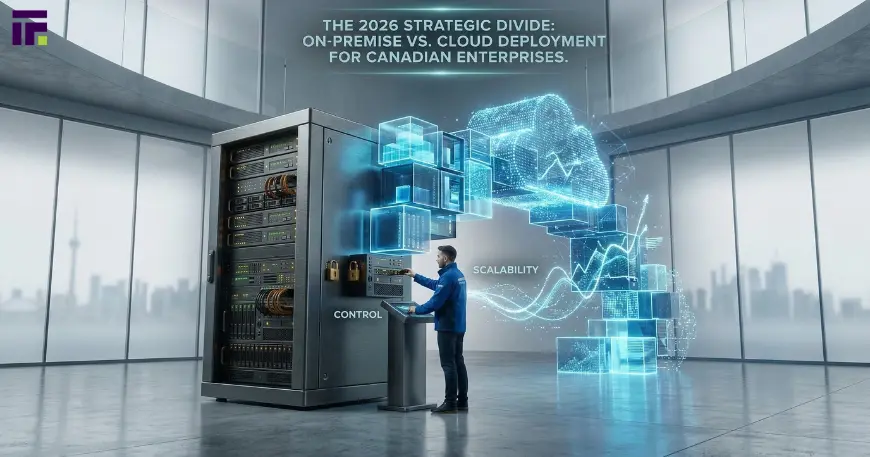
Choosing how to run your business software is a big deal. For many years, companies in Canada kept all their computers and data in their own buildings. This is what we call enterprise computing software. Now, many businesses are moving their information to the internet. This shift is a key part of digital transformation, helping companies become more flexible and competitive in the modern market.
If you are a business owner in Toronto, Vancouver, or anywhere in between, you might be wondering which one is better. Should you keep your own servers or use a cloud service? In this article, we will break down the on-premise vs. cloud comparison and look at the big differences to help you decide.
Understanding Enterprise Computing Software and Deployment
Before we dive deep, let us talk about what these words mean. Enterprise computing software is just a fancy name for the big programs that companies use to do work. Mastering enterprise application development ensures these programs are scalable and secure, regardless of where they are hosted.
There are two main ways to do this. You can have it on your own site or you can have it in the cloud. Both ways have good points and bad points. It all depends on what your company needs.
What is On-Premise Meaning in Business?
When we talk about the on-premises meaning, we mean that the software is installed on computers located inside your own building. You own the hardware. You own the software. You are the boss of everything. This level of control is often why companies choose custom software development to build systems that match their specific security and operational workflows exactly.
The On-Premise Data Center
In this setup, a company usually has a special room. This is the on-premises data center. It is full of servers, wires, and cooling fans. Because the computers are right there, your IT team can touch them and fix them whenever they want. This gives a business a lot of control.
Why Some Canadian Companies Like On-Premise
Many businesses in Canada, like banks or health clinics, have very strict rules. They need to keep data very safe and private. By keeping everything in their own building, they feel they have more power over who sees the information.
Comparing Cloud vs On-Premise Deployment
Now let us look at the cloud. The cloud means your software and data live on the internet. They are kept in giant data centers owned by companies like Microsoft or Google.
Private Cloud vs On Premise
You might hear people talk about a ‘private cloud vs on premise’. A private cloud is like a middle ground. It uses cloud technology but it is only for one company. Even though it acts like the cloud, it can still be kept on your own servers or at a special provider.
Flexibility and Scaling
The cloud is very easy to grow. If your business in Montreal suddenly gets a thousand new customers, you can add more “space” in the cloud with just a few clicks. With on-premise, you would have to go out and buy new metal boxes and plug them in. That takes a lot of time and work.
The Cloud vs On-Premise Comparison Chart
To make it easy to understand, here is a quick way to look at the differences:
- Cost: On-premise costs a lot at the start. Cloud costs a small amount every month.
- Setup: On-premise takes a long time to build. Cloud is ready almost right away.
- Updates: You have to update on-premise yourself. The cloud provider updates the cloud for you.
- Security: On-premise gives you physical control. Cloud uses high-tech digital locks.
Why You Should Care About Software Development Methodologies
When you choose where your software lives, you also need to think about how it is built. Some ways of building software work better in the cloud. Others are fine for your own building. You can learn more about this by reading about the best software development methodologies. This will help you see how the “how” and the “where” work together.
Is the Cloud Cheaper for Your Business?
A big question for every Canadian manager is about money. Is it cheaper to buy your own servers or pay a monthly fee?
Upfront Costs
On-premise is like buying a car. You pay a lot of money at the start. You also have to pay for the garage (the server room) and the mechanic (the IT staff).
Monthly Fees
The cloud is more like taking a bus or renting a car. You pay for what you use. This is called “Pay as you go.” For many small businesses, this is much easier to handle because they do not need to have a huge pile of cash at the beginning.
Security and Control in Canada
Security is very important. If you lose your customer data, your business could be in big trouble.
Physical Security
With an on-premise setup, you can lock the door to the server room. You know exactly where your data is sitting. For some people, this makes them feel very safe.
Cyber Security
Cloud providers spend millions of dollars on security. They have teams of people watching for hackers 24 hours a day. Most small or medium businesses in Canada cannot afford to hire that many security experts on their own.
Custom Solutions for Your Company
Sometimes, a basic program off the shelf is not enough. You might need something made just for you. If you need a special program that fits your business perfectly, you should look at custom software development. Whether you want it in the cloud or on your own servers, a custom build can make your work much easier.
Performance and Speed
How fast does your software run? This is a big part of enterprise computing software.
Local Speed
If your servers are in the same building as your workers, the connection is usually very fast. There is no lag because the data doesn’t have to travel across the country.
Internet Speed
If you use the cloud, you need a very good internet connection. If the internet goes down, your work might stop. Luckily, most cities in Canada have very fast internet now, so this is becoming less of a problem.
Making the Final Choice
So, which one should you pick for your Canadian enterprise?
Choose On-Premise if:
- You have very strict rules about where data is stored.
- You already have a great IT team and a server room.
- You do not want to rely on the internet to get your work done.
Choose Cloud if:
- You want to start quickly.
- You want your team to work from anywhere.
- You want to pay a small monthly fee instead of a big bill at the start.
Conclusion
Choosing between cloud and on-premise deployment is a big step for your business. Both options can work well. The cloud offers ease and flexibility, while on-premise offers control and privacy. In Canada, many businesses are moving to a “hybrid” model. This means they keep some things in their own building and some things in the cloud. This gives them the best of both worlds.
If you are still not sure which path to take, it helps to talk to experts. Getting the right advice early can save you a lot of money and headaches later on. Whether you need a new cloud app or a system for your office, the right software will help your business grow.
Ready to build the perfect system for your business? Visit our custom software development page today to see how we can help you succeed in the digital world!
Frequently Asked Questions (FAQ)
What is an example of on-premise?
A common example is a company that has its own email server in the basement. Instead of using a web-based email like Gmail, they use a program that is installed on their own hardware. Another example is a school that keeps all student grades on a computer kept in the main office.
Why move to cloud from on-premise?
Many businesses move to the cloud because they want to save time. They don’t want to worry about fixing broken computer parts or cooling a hot server room. Moving to the cloud also lets employees work from home more easily because they can get to the software from anywhere with an internet connection.
What is cheaper? cloud or on-premise
This depends on how long you look at it. At the start, the cloud is almost always cheaper because you don’t have to buy expensive equipment. However, over ten years, paying a monthly fee might add up to be more than the cost of owning your own server. You have to decide if you prefer a big one-time cost or a small, steady cost.

