

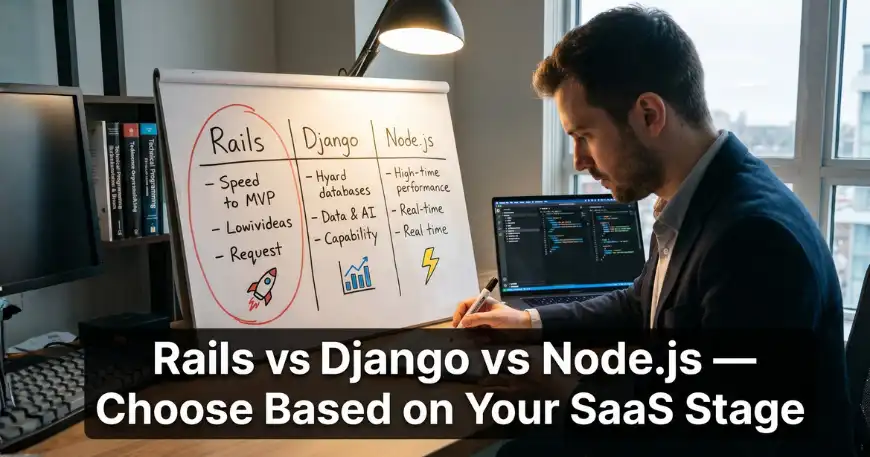
Choosing the right backend in ruby on rails vs django vs node can slow your SaaS before it even grows.
In early-stage products, speed matters. In scaling products, stability matters. And in modern SaaS, especially in Canada’s competitive market, both matter at the same time.
That’s why the comparison around ruby on rails vs django vs node is not just a developer debate it is a strategic decision for founders and CTOs.
Each option solves a different problem:
- Speed of development and MVP delivery
- Real-time performance and scalability
- Data-heavy and AI-ready architecture
At Innofast, we consistently see that teams struggle not because they pick the “wrong” technology, but because they don’t match the backend to the product stage and growth plan.
This guide breaks down each stack in a clear, practical way so you can choose based on real SaaS needs not assumptions.
Choosing a Tech Stack Based on Predictable Growth
A SaaS backend should not be chosen based only on popularity or developer preference. It should be aligned with how your product is expected to grow over time.
In the context of ruby on rails vs django vs node, each framework supports a different type of growth pattern. Some are optimized for fast product launches, while others are designed for long-term scalability and complex system handling.
This is where backend framework comparison becomes important for founders and CTOs. You need to evaluate not just how fast you can build, but also how your system will behave when user traffic increases, features expand, and data complexity grows.
Key factors to consider include:
- Speed of MVP development
- Long-term scalability requirements
- System complexity and integrations
- Future AI or data-driven capabilities
The right decision is not about choosing the “best” framework overall, but choosing the one that matches your predictable growth path.
Ruby on Rails vs Django vs Node.js: Core Technical Comparison
In the ruby on rails vs django vs node comparison, each backend follows a different architecture philosophy. The right choice depends on whether you prioritize speed, structure, or real-time scalability.
Ruby on Rails vs Django vs Node.js: A Quick Comparison Table
| Feature / Factor | Ruby on Rails | Django | Node.js |
| Core Language | Ruby | Python | JavaScript |
| Primary Strength | Rapid development & MVP speed | Data-heavy apps & strong structure | Real-time performance & scalability |
| Architecture Style | Convention over configuration | Batteries-included, structured | Event-driven, non-blocking |
| Best Use Case | SaaS MVPs, startups, fast iteration | AI-driven apps, data platforms, secure systems | Chat apps, live systems, high traffic SaaS |
| Learning Curve | Easy–moderate | Moderate | Moderate (depends on JS familiarity) |
| Performance Focus | Development speed | Stability & data handling | High concurrency & runtime efficiency |
| Scaling Type | Vertical scaling with simplicity | Stable scaling for complex systems | Horizontal scaling for real-time systems |
Rails is best for speed, Django is best for structured data systems, and Node.js is best for real-time, high-traffic applications.
Why Ruby on Rails Remains the Leader for Rapid SaaS Iteration
Ruby on Rails is still widely used in early-stage SaaS because it prioritizes speed, structure, and simplicity in product development.
In the ruby on rails vs django vs node discussion, Rails is often chosen when the primary goal is to launch an MVP quickly and validate the product in the market. It reduces setup complexity and allows teams to focus on core business logic instead of infrastructure decisions.
This is why it remains strong in best tech stack for saas startups conversations, especially for founders who need fast iteration cycles and predictable development speed.
Rails performs particularly well in early-stage environments where:
- Product requirements change frequently
- Time-to-market is critical
- Small teams need high output efficiency
In simple terms: Rails helps you build and launch faster with fewer technical decisions slowing you down.
Convention Over Configuration as a Speed Multiplier
Rails follows the principle of “convention over configuration”, which means the framework makes most structural decisions for you instead of requiring manual setup for every part of the application.
This reduces development complexity significantly. Developers don’t need to spend time defining folder structures, repetitive configurations, or boilerplate code. Instead, they can immediately focus on building core product features and business logic.
In the context of rails vs node performance, this does not refer to runtime speed but to development velocity, especially in early-stage SaaS builds where time-to-market is critical.
This approach is one of the key reasons Rails is still widely used in MVP development and early SaaS product launches.
When Node.js Is the Correct Choice for Real-Time Scaling
Node.js becomes the strongest option when your SaaS product depends on real-time interactions and needs to handle many users at the same time.
In the ruby on rails vs django vs node decision, Node.js stands out for applications where speed of response and continuous data flow are critical. It is built on a non-blocking, event-driven architecture, which allows it to process multiple requests efficiently without slowing down the system.
This makes it a strong fit for modern SaaS platforms that require startup backend scalability, especially in products where users expect instant updates and live interactions.
Common use cases include:
- Live chat and messaging systems
- Real-time dashboards and analytics
- Collaborative tools and streaming platforms
Node.js is the best choice when your SaaS needs to stay fast even when thousands of users are active at the same time.
Handling High Concurrency and Event-Driven Architecture
One of the main reasons developers choose Node.js in the ruby on rails vs django vs node comparison is its ability to handle high concurrency using an event-driven, non-blocking model.
Instead of creating a new process for every request, Node.js processes multiple operations asynchronously. This makes it highly efficient for applications where many users interact with the system at the same time, such as real-time SaaS platforms and collaborative tools.
This architecture is especially important for startup backend scalability, where traffic can grow quickly and unpredictably. Node.js handles this growth by efficiently managing I/O-heavy operations like API calls, database queries, and live updates without slowing down performance.
It is commonly used in systems that require the following:
- Continuous data streaming
- High-frequency user interactions
- Real-time updates across multiple clients
So, Node.js keeps your SaaS responsive even when thousands of users are interacting with it at once.
Django: The Data-Heavy Alternative for AI-First Products
Django is often the preferred choice when SaaS products are built around data, structure, and long-term reliability in the ruby on rails vs django vs node comparison.
Built on Python, Django is designed for secure and scalable applications where data processing plays a central role. It follows a “batteries-included” approach, meaning it comes with built-in features for authentication, admin control, and database management—reducing the need for external dependencies.
This makes Django especially strong for django vs rails for web development scenarios where applications require strict structure and clean architecture. It is also widely used in django vs rails for AI integration because Python’s ecosystem supports machine learning, data science, and AI libraries more naturally.
Django is commonly used in:
- Data-heavy SaaS platforms
- AI-driven applications
- Secure enterprise systems with complex workflows
Django is the best choice when your SaaS depends heavily on data, security, and AI capabilities rather than just speed of development.
Comparative Performance: Development Velocity vs. Raw Execution
In the ruby on rails vs django vs node comparison, performance is not a single measurement. Each framework performs differently depending on whether you are focusing on building speed, data handling, or real-time system load.
Instead of treating them as direct competitors, it is more accurate to compare them based on what they are optimized for:
A Quick Performance Comparison Table –
| Factor | Ruby on Rails | Django | Node.js |
| Development Speed | Very high (fast MVP delivery) | Moderate | Moderate–high (depends on architecture) |
| Runtime Performance | Moderate | High for data-heavy apps | Very high for real-time systems |
| Data Handling | Moderate | Excellent (Python ecosystem advantage) | Moderate (requires additional setup) |
| Real-Time Scalability | Limited | Moderate | Excellent (event-driven model) |
| Best Optimization Focus | Rapid product development | Data security & AI workloads | High concurrency & live systems |
This is why backend framework comparison is not about picking a universal winner, but about matching the framework to the product’s technical priorities.
So in simple terms: Rails is optimized for speed of building, Django for data strength, and Node.js for real-time performance at scale.
The 2026 Decision Framework for Canadian CTOs
For Canadian CTOs and technical founders, the ruby on rails vs django vs node decision in 2026 is less about popularity and more about aligning backend choice with business goals and scaling expectations.
In modern SaaS planning, teams are no longer selecting frameworks in isolation. Instead, they evaluate how each option supports startup backend scalability, long-term maintenance, and future AI or real-time feature requirements.
A practical decision approach looks like this:
- If the goal is fast market validation → choose Ruby on Rails
- If the product is data-heavy or AI-focused → choose Django
- If the product requires real-time performance at scale → choose Node.js
This approach reflects a real-world best backend for high-traffic SaaS in Canada mindset, where architecture decisions must balance speed, stability, and scalability from day one.
The right backend is not the most powerful one—it is the one that matches your product stage and growth plan.
Wrapping Up: Choosing the Right Backend Rails vs. Django vs. Node.js
In the ruby on Rails vs. Django vs. Node.js comparison, there is no universal “best” backend only the best fit for your product stage and business model.
If your priority is speed, Ruby on Rails gives you the fastest path to launch and validate your idea. If your product is built around data, security, or AI, Django provides the structure and ecosystem needed for long-term intelligence. If your focus is real-time performance and high user concurrency, Node.js delivers the scalability needed for modern interactive SaaS platforms.
What most startups get wrong is trying to choose a “perfect” stack instead of a practical growth-aligned stack. In reality, your backend should evolve with your product—not restrict it.
At Innofast, we consistently see one clear pattern:
Startups that align architecture with growth stage move faster, scale smoother, and avoid costly rebuilds later.
So the real question is not which backend is the best but:
which backend is best for where your SaaS is going next?
That is where the right decision creates long-term advantage.
Some Common FAQs on Ruby on Rails vs. Django vs. Node.js
1. Should I use Node.js for my first startup backend?
Node.js is a good choice if your product needs real-time features like chat, live updates, or streaming. For simpler SaaS MVPs, it may require more setup compared to Rails.
2. Why do startups still choose Rails over Django?
Startups prefer Ruby on Rails because it enables faster MVP development, follows strong conventions, and reduces early-stage architectural decisions.
3. Which is better for a startup: Rails or Node.js?
Rails is better for fast MVP development, while Node.js is better for real-time scalability. The best choice depends on your product type and growth plan.
4. Is Node.js overkill for a SaaS MVP?
Yes, in many cases. If your SaaS does not require real-time systems, Node.js can add unnecessary complexity compared to Rails.
5. Can Django be used for SaaS startups?
Yes, Django works well for SaaS startups that are data-heavy, require strong security, or plan to integrate AI and analytics early.
6. What backend do most SaaS startups start with?
Many startups begin with Ruby on Rails because it offers faster development speed and easier MVP validation before scaling.
7. Is Ruby on Rails faster for MVP than Node.js?
Yes, in most cases Rails is faster for MVP development because it comes with built-in conventions and reduces setup time.
8. How do I choose the best backend for my startup?
Choose Rails for speed, Django for data and AI-heavy systems, and Node.js for real-time and high-concurrency applications.

